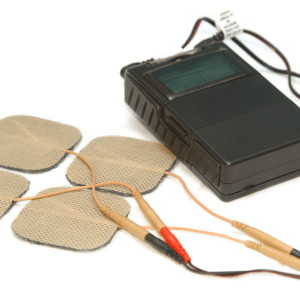
Transcutaneous Electrical Nerve
Stimulation
Author: Vladimir Kaye, MD,
Consulting Staff, Departments of Neurology and Psychiatry, Hoag
Hospital
Coauthor(s): Murray E Brandstater, MBBS, PhD,
Chairman and Program Director, Professor, Department of
Physical Medicine and Rehabilitation, Loma Linda University
School of Medicine
Contributor Information and Disclosures
Updated: Oct 8, 2008
Introduction
Transcutaneous electrical nerve stimulation (TENS) currently
is one of the most commonly used forms of electroanalgesia.
Hundreds of clinical reports exist concerning the use of TENS
for various types of conditions, such as low back pain (LBP),
myofascial and arthritic pain, sympathetically mediated pain,
bladder incontinence, neurogenic pain, visceral pain, and
postsurgical pain. Because many of these studies were
uncontrolled, there has been ongoing debate about the degree to
which TENS is more effective than placebo in reducing pain.
The currently proposed mechanisms by which TENS produces
neuromodulation include the following:
Presynaptic inhibition in the dorsal horn of
the spinal cord
Endogenous pain control (via endorphins, enkephalins, and
dynorphins)
Direct inhibition of an abnormally excited nerve
Restoration of afferent input
The results of laboratory studies suggest that
electrical stimulation delivered by a TENS unit reduces pain
through nociceptive inhibition at the presynaptic level in the
dorsal horn, thus limiting its central transmission. The
electrical stimuli on the skin preferentially activate
low-threshold, myelinated nerve fibers. The afferent input from
these fibers inhibits propagation of nociception carried in the
small, unmyelinated C fibers by blocking transmission along
these fibers to the target or T cells located in the substantia
gelatinosa (laminae 2 and 3) of the dorsal horn.
Studies show marked increases in beta endorphin and
met-enkephalin with low-frequency TENS, with demonstrated
reversal of the antinociceptive effects by naloxone. These
effects have been postulated to be mediated through
micro-opioid receptors. Research indicates, however, that
high-frequency TENS analgesia is not reversed by naloxone,
implicating a naloxone-resistant, dynorphin-binding receptor. A
sample of cerebral spinal fluid in those subjects demonstrated
increased levels of dynorphin A.
The mechanism of the analgesia produced by TENS is explained
by the gate-control theory proposed by Melzack and Wall in
1965.7 The gate usually is closed, inhibiting constant
nociceptive transmission via C fibers from the periphery to the
T cell. When painful peripheral stimulation occurs, however,
the information carried by C fibers reaches the T cells and
opens the gate, allowing pain transmission centrally to the
thalamus and cortex, where it is interpreted as pain. The
gate-control theory postulates a mechanism by which the gate is
closed again, preventing further central transmission of the
nociceptive information to the cortex. The proposed mechanism
for closing the gate is inhibition of the C-fiber nociception
by impulses in activated myelinated fibers.
Technical Considerations
A transcutaneous electrical nerve stimulation (TENS) unit
consists of 1 or more electrical-signal generators, a battery,
and a set of electrodes. The TENS unit is small and
programmable, and the generators can deliver trains of stimuli
with variable current strengths, pulse rates, and pulse widths.
The preferred waveform is biphasic, to avoid the electrolytic
and iontophoretic effects of a unidirectional current. The
usual settings for the stimulus parameters used clinically are
the following:
Amplitude - Current at a comfortable, low
intensity level, just above threshold
Pulse width (duration) - 10-1000
microseconds
Pulse rate (frequency) - 80-100 impulses per second (Hz); 0.5-10 Hz
when the stimulus intensity is set high
When TENS is used analgesically, patients are instructed to
try different frequencies and intensities to find those that
provide them with the best pain control. Optimal settings of
stimulus parameters are subjective and are determined by trial
and error. Electrode positioning is quite important. Usually,
the electrodes are initially placed on the skin over the
painful area, but other locations (eg, over cutaneous nerves,
trigger points, acupuncture sites) may give comparable or even
better pain relief.
The 3 options for the standard settings used in different
therapeutic methods of TENS application include the
following:
- Conventional TENS has a high stimulation frequency
(40-150 Hz) and low intensity, just above threshold, with
the current set between 10-30 mA. The pulse duration is
short (up to 50 microseconds). The onset of analgesia with
this setup is virtually immediate. Pain relief lasts while
the stimulus is turned on, but it usually abates when the
stimulation stops. Patients customarily apply the
electrodes and leave them in place all day, turning the
stimulus on for approximately 30-minute intervals
throughout the day. In individuals who respond well,
analgesia persists for a variable time after the
stimulation stops.
- In acupuncturelike settings, the TENS unit delivers low
frequency stimulus trains at 1-10 Hz, at a high stimulus
intensity, close to the tolerance limit of the patient.
Although this method sometimes may be more effective than
conventional TENS, it is uncomfortable, and not many
patients can tolerate it. This method often is considered
for patients who do not respond to conventional
TENS.
- Pulsed (burst) TENS uses low-intensity stimuli firing
in high-frequency bursts. The recurrent bursts discharge at
1-2 Hz, and the frequency of impulses within each burst is
at 100 Hz. No particular advantage has been established for
the pulsed method over the conventional TENS method.
Patient comfort is a very important determinant of
compliance and, consequently, of the overall success of
treatment. The intensity of the impulse is a function of pulse
duration and amplitude. Greater pulse widths tend to be more
painful. The acupuncturelike method is less tolerable, because
the impulse intensity is higher.
The amount of output current depends on the combined
impedance of the electrodes, skin, and tissues. With repetitive
electrical stimuli applied to the same location on the skin,
the skin impedance is reduced, which could result in greater
current flow as stimulation continues. A constant current
stimulator, therefore, is preferred in order to minimize
sudden, uncontrolled fluctuations of current intensity related
to changes in impedance. An electroconductive gel applied
between the electrode and skin serves to minimize the skin
impedance.
Medical complications arising from use of TENS are rare.
However, skin irritation can occur in as many as 33% of
patients, due, at least in part, to drying out of the electrode
gel. Patients need to be instructed in the use and care of TENS
equipment, with particular attention to the electrodes.
In some cases, individuals react to the tape used to secure
the electrodes. Skin irritation is minimized by using
disposable, self-adhesive electrodes and repositioning them
slightly for repeated applications. The use of TENS is
contraindicated in patients with a demand-type pacemaker,
because the stimulus output of the TENS unit may drive or
inhibit the pacemaker.
A variety of newer transcutaneous or percutaneous electrical
stimulation modalities have emerged. They include the
following:
- Interferential current therapy (IFC) is based on
summation of 2 alternating current signals of slightly
different frequency. The resultant current consists of a
cyclical modulation of amplitude, based on the difference
in frequency between the 2 signals. When the signals are in
phase, they summate to an amplitude sufficient to
stimulate, but no stimulation occurs when they are out of
phase. The beat frequency of IFC is equal to the difference
in the frequencies of the 2 signals. For example, the beat
frequency and, hence, the stimulation rate of a dual
channel IFC unit with signals set at 4200 and 4100 Hz is
100 Hz.
- IFC therapy can deliver higher currents than TENS can.
IFC can use 2, 4, or 6 applicators, arranged in either the
same plane, for use on such regions as the back, or in
different planes in complex regions (eg, the
shoulder).
- Percutaneous electrical nerve stimulation (PENS)
combines advantages of electroacupuncture and TENS. Rather
than using surface electrodes, PENS uses acupuncturelike
needle probes as electrodes, with these placed at
dermatomal levels corresponding to local pathology. The
main advantage of PENS over TENS is that it bypasses local
skin resistance and delivers electrical stimuli at the
precisely desired level in close proximity to the nerve
endings located in soft tissue, muscle, or
periosteum.3
Applications of Tens in Clinical
Practice
Literature on the effectiveness of transcutaneous electrical
nerve stimulation (TENS) in a variety of medical conditions
reports a wide range of outcomes, from very positive to
negative. Currently, there is an overall consensus favoring the
use of TENS, with authorities differing on its value in
different clinical situations. Generally, TENS provides initial
relief of pain in 70-80% of patients, but the success rate
decreases after a few months or longer to around 20-30%. To
exclude a false-negative response, a trial of TENS for at least
1 hour should be given to confirm potential benefit from
subsequent continuous use.
According to Johnson, the time from the start of stimulation
to the onset of analgesia varies from almost immediate to hours
(on average, 20-30 minutes in over 75% of patients and 1 hour
in 95% of patients).8 The duration of analgesia also varies
considerably, continuing only for the duration of stimulation
in some patients and providing considerable, prolonged
poststimulation relief in others. The same TENS protocol may
have different degrees of antinociception in acute experimental
pain compared with chronic clinical pain in patients with
chronic low back pain (LBP).9
Patients differ in their stimulus preferences and in their
rates of compliance. In Johnson's study of compliance in
patients who benefited from TENS, 75% used the device on a
daily basis. Patients showed individual preferences for
particular pulse frequencies and patterns, and they
consistently adjusted their stimulators to these settings in
subsequent treatment sessions.
Indications for the use of TENS
- Neurogenic pain (eg, deafferentation pain, phantom
pain), sympathetically mediated pain, postherpetic
neuralgia, trigeminal neuralgia, atypical facial pain,
brachial plexus avulsion, pain after spinal cord injury
(SCI)
- Musculoskeletal pain - Examples of specific diagnoses
include joint pain from rheumatoid arthritis and
osteoarthritis, acute postoperative pain (eg,
postthoracotomy), and acute posttraumatic pain.10, 11,
12, 13, 14, 15, 16 After surgery, TENS is most
effective for mild to moderate levels of pain, and it is
ineffective for severe pain. The use of TENS in chronic LBP
and myofascial pain is controversial, with
placebo-controlled studies failing to show statistically
significant beneficial results. Uncertainty also exists
about the value of TENS in tension headache.
- Visceral pain and dysmenorrhea - TENS has been
successfully applied to these conditions as
well.17
- Other disorders - TENS has been used successfully in
patients with angina pectoris and urge incontinence, as
well as in patients requiring dental anesthesia.18,
19 Reports discuss the use of TENS to assist patients
in regaining motor function following stroke, to control
nausea in patients undergoing chemotherapy, as an opioid
-sparing modality in postoperative recovery, and in
postfracture pain.20, 21, 22, 23, 24, 25,
26
Contraindications for the use of TENS
TENS should not be used in patients with a pacemaker
(especially of the demand type).
TENS should not be used during pregnancy, because it may induce
premature labor.
TENS should not be applied over the carotid sinuses due to the
risk of acute hypotension through a vasovagal reflex.
TENS should not be placed over the anterior neck, because
laryngospasm due to laryngeal muscle contraction may occur.
The electrodes should not be placed in an area of sensory
impairment (eg, in cases of nerve lesions, neuropathies), where
the possibility of burns exists.
A TENS unit should be used cautiously in patients with a spinal
cord stimulator or an intrathecal pump.
Comparison Between Tens and Other Electrical
Modalities
A number of studies have compared transcutaneous electrical
nerve stimulation (TENS) with similar therapeutic modalities,
including percutaneous electrical nerve stimulation (PENS),
interferential current therapy (IFC), and acupuncture.17,
27 The results included the following:
- In one study of elderly patients with chronic low back
pain (LBP), acupuncture and TENS had demonstrable benefits,
with the acupuncture group demonstrating improvement in
spinal flexion.
- In patients with chronic LBP and sciatica, PENS was
more effective than TENS in providing short-term pain
relief and improved function, including an improved quality
of sleep and sense of well-being.
- Overall, 91% and 73% of patients, respectively, chose
PENS as the preferred modality for pain relief in LBP and
sciatica.
- PENS has been used successfully for pain relief in
patients with acute herpes zoster and in persons suffering
from cancer with bony metastases.
- IFC and TENS had a statistically significant effect on
the median nerve excitation threshold in young women.
References
Electrical Stimulation for Pain
Using Elecitrical Stimulation for Pain is not
a new concept. Several modalities of electrical
stimulation exist for the treatment of chronic pain. Below are
some examples and explanations:
TENS: Transcutaneous Electrical Nerve
stimulator is a device used to treat chronic intractable pain,
and pain associated with active or post- traumatic injury
unresponsive to other standard pain therapies. The device is
applied to the surface of the skin at the site of the pain. It
consists of an electrical pulse generator, usually battery
operated, connected by a wire to two or more electrodes. A
programmable stimulator may be programmed in advance to
stimulate at regular times or upon demand by the use of a hand
held magnet over the stimulator. ( Neuro Cybernetic Prosthesis
System )
MNS: Microcurrent Nerve Stimulator works on
the same principal as TENS by delivering microcurrent instead
of regular current.
PENS: Percutaneous Nerve Stimulator is
similar to TENS, with the exception that instead of electrodes
attached to the skin near the pain area, in PENS, a needle is
inserted into the pain site.
PNT: Percutaneous neuromodulation
therapy is a variant of PENS in which up to 10 fine filament
electrodes are temporarily placed at specific anatomical
landmarks in the back. Treatment regimens consist of
30-minute sessions, once or twice a week for 8 to 10
sessions.
VNS: Vagus Nerve Stimulation Implanted
vagus nerve stimulation (VNS) devices have been used to treat
patients with medically refractory partial-onset seizures for
whom surgery is not recommended or for whom surgery has failed.
Surgery for implantation of the VNS device is done with the
patient under either general anesthesia or regional cervical
block. Since right vagus nerve stimulation produces
bradycardia, implantation is limited to left-sided unilateral
implantations. Two spiral electrodes are implanted around the
left vagus nerve within the carotid sheath, which are connected
to an infraclavicular generator pack. A programmable stimulator
may be programmed in advance to stimulate at regular times or
upon demand by the use of a hand held magnet over the
stimulator. ( Neuro Cybernetic Prosthesis System )
FNS: Functional Neuromuscular Stimulation
attempts to replace stimuli from destroyed nerve pathways with
electrical stimulation to the muscles. It is presumed that
electric stimulation enables the spinal cord injured patient to
stand or walk independently, or to maintain healthy muscle tone
and strength.
NMES: Neuromuscular Electric Stimulator for
disuse atrophy. NMES involves the use of a device that
transmits an electrical impulse to activate muscle groups by
way of electrodes. There are two broad categories of
NMES. One type of device stimulates the muscle when the
patient is in a resting state to treat muscle atrophy.
The second type is used to enhance functional activity of
neurologically impaired patients.
Spinal Cord Stimulation for Chronic
Pain: Electrodes are implanted in the epidural
space to stimulate the dorsal column and treat chronic
pain.
DBS: Deep Brain Stimulation of the thalamus
has been used as an alternative to permanent neuroablative
procedures such as thalamotomy and pallidotomy for control of
essential tremor, and tremors associated with Parkinson's
disease. It involves stereotactic placement of an
electrode into the brain, which is attached to a temporary
transcutaneous cable for short-term stimulation to validate
treatment effectiveness. Several days later a permanent
subcutaneous programmable stimulator is implanted. DBS of
the globus pallidus and subthalamic nucleus has also been
investigated for other symptoms of Parkinson's disease such as
rigidity, bradykinesia or akinesia. DBS is also FDA
approved for the treatment of dystonia.
H-Wave® Electric Stimulation: This device
is used for the treatment of pain related to a variety of
etiologies. This is also used for wound healing.
Sensory Stimulation for Coma Patients:
Sensory stimulation is intended to enhance awakening and
rehabilitative potential of coma patients. Treatment may
be delivered in the hospital, the patient's home, or a nursing
home by professionals including nurses, occupational therapist,
physical therapist, speech language therapist and even by a
trained family member.
TES: Threshold Electric Stimulator as a
treatment of motor disorders. Low intensity electrical
stimulation is used to target spastic muscles during sleep at
home. Although the exact mechanism of action is not known, it
is presumed that it may increase muscle strength and joint
mobility leading to improved voluntary motor function. This is
used in children with spastic paraplegia related to cerebral
palsy and also in those with other motor disorders, such as
spina bifida.
Sympathetic therapy as a treatment of chronic pain
(i.e. Dynatron STS): Sympathetic therapy describes a
type of electrical stimulation of the peripheral nerves that is
designed to stimulate the sympathetic nervous system in an
effort to 'normalize' the autonomic nervous system and
alleviate chronic pain. Sympathetic therapy is not
designed to treat local pain, but is designed to induce a
systemic effect on sympathetically induced pain.
Interferential current stimulation (IFC) is
a type of electrical current treatment that uses paired
electrodes of two independent medium-frequency alternating
currents. The electrodes are arranged on the skin so the
current flowing between each pair intersects at the underlying
target. IFC has been investigated as a technique to reduce
pain, improve range of motion, or promote local healing.
LymphavisionTM is an electrical stimulation
device that stimulates smooth muscles thereby promoting
lymphatic flow. It is described as a treatment for such
conditions as diabetic foot syndrome and trophic ulcers, and
prevention of deep vein thrombosis.
TEJS: Transcutaneous electrical joint
stimulation is the application of a signal-specific electrical
current to the joint tissue to relive the signs and symptoms of
osteoarthritis of the knee. Two electrode patches are worn for
six to ten hours a day, preferably while the patient is
sleeping. TEJS has been indicated as adjunctive therapy for
patients who have failed NSAIDS, those with moderate to severe
disease despite best medical therapy, and those with severe
disease who are not surgical candidates for reasons such as
morbid obesity and inappropriate age.
PES: Pulsed electrical stimulation is
provided by an electronic device that noninvasively delivers a
low voltage, monophasic electrical field to the targeted area
of pain. It is used to improve functional status and relieve
pain related to osteoarthritis and rheumatoid arthritis
unresponsive to other standard forms of treatment.
Reference: Wellmark, Blue Cross Blue
Shield.
|